
Written by: Niels Tuijl, baby osteopath in Amsterdam.
A baby who almost always keeps his head turned to the same side: many parents have to deal with this. A preferred posture is common and can quickly lead to a flattening of the skull. This understandably causes concern, because such a preferred attitude can hinder symmetrical development. The good news: with practical tips you can prevent a lot as a parent, and as an osteopath I can provide targeted support.
How does a flattened head develop?
During childbirth, your baby's head comes under enormous pressure. Because the skull bones are still flexible and are separated by thin seams (sutures), they can slide slightly over each other to fit through the birth canal. After birth, they normally resume their own position.
Sometimes it happens that the skull no longer takes its normal shape and a flattening occurs. We also call this plagiocephaly or brachycephaly. Important to know: when the skull deforms due to a posture, we speak of a positional (deformative) deformation. This is very different from craniosynostosis — the premature closing of the cranial sutures — which always requires medical assessment.
The two forms of positional skull deformity
Within the positional skull deformities we distinguish two main forms, which can also occur as a mixed form:
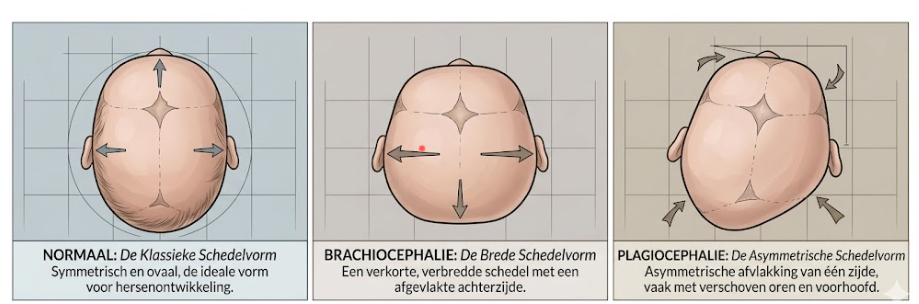
- Plagiocephaly (asymmetric): the back of the head is flattened on one specific side, creating a crooked, asymmetrical skull shape.
- Brachycephaly (symmetric): the back of the head is evenly flattened across its entire width, resulting in a shorter and wider head.
- Mixed form: a combination of both, where the skull is both shorter and asymmetrical in shape.
Characteristics of plagiocephaly (asymmetric)
In this shape, the skull is pressed into an asymmetrical (oblique) shape. You recognize it by:
- A crooked or flattened back of the head on one side.
- A shifting of the ear (placed differently on one side).
- A forehead pushed forward on the flattened side.
- A low-set eyebrow on one side.
- A jaw and chin that deviate to the other side.
Characteristics of brachycephaly (symmetrical)
With this shape, the deformation is more evenly distributed over the back. You recognize it by:
- A clearly flattened back of the head.
- A noticeably short and broad skull.
Associated signals
If a preferential position or flattening has a cause surrounding pregnancy or birth, this is often accompanied by a broader impact on your baby's body. Common signals are:
- A history of a transverse or breech presentation.
- A difficult birth, such as artificial delivery with vacuum or forceps.
- A poor or difficult sucking reflex.
- I suffer a lot from intestinal cramps.
- Excessive crying and restlessness.
- High muscle tension (the body feels very tense or overstretched).
- Disturbed or asymmetrical ocular motor skills.
Causes and risk factors
Around birth (perinatal)
During childbirth, the back of the head (occiput) experiences the greatest pressure against the mother's pubic bone. This can immediately push the skull into a crooked shape. The risk of this is greater with a long expulsion period, artificial delivery (vacuum or forceps) and unusual starting positions of the baby during birth.
After birth
The skull is most sensitive to pressure, especially around the age of 2 to 3 weeks. Risk factors are then:
- A preferred position: your baby almost always keeps his head turned to one side (often to the right), even when awake. This constant one-sided lying can lead to crooked growth or flattening.
- Sleeping position: Sleeping on your back is the safest position (and remains the advice), but at the same time the greatest risk factor for a flat back of the head.
- Limited movement: too much use of the Maxi-Cosi outside of travelling, causing your baby to lie on their back.
- One-sided care: Use the same arm every time when bottle feeding, or always hold your baby on the same side when carrying.
- One-sided incentives: light and sound that always come from one side, for example because the bed is against the wall.
- Too little prone position: Don't let your baby play on the stomach enough during the day (tummy time).
Practical tips for parents: prevention and care
To break or prevent a preferred attitude, active variety is the most important thing. Some effective tips:
- Tummy time (prone position): Let your baby play on his stomach at least 3 times a day when he is awake. Start with about five minutes in the first few weeks and build up to half an hour around the age of 3 months. This strengthens the neck and back muscles and stimulates the natural rounding of the back of the head. Tip: a rolled-up cloth under the armpits makes lifting the head easier.
- Playing in the box: alternate between back, side and stomach positions. Change the direction of toys, lights and sounds regularly so that your baby is encouraged to look in both directions.
- Feeding and carrying: Switch arms consistently when bottle feeding (this happens naturally when breastfeeding). Also carry your baby alternately on the left and right arm.
- Rotary lifting: When picking your baby up, first roll them gently onto their side. Encourage your child to raise his or her head during the slow lifting process. Always support the back of the head and torso.
- Limit the Maxi-Cosi: use the car seat purely for transportation, a maximum of about 1.5 hours per day. Do not use it as a stroller or fixed seat during the day.
What can the osteopath do?
Does a preferred position or flattening remain persistent, or does your baby show a lot of restlessness? Then an osteopath with experience in pediatric osteopathy can help. I examine your baby in a respectful and gentle manner and look at its entire functioning: the musculoskeletal system, the organ system and the craniosacral system. Feel free to read more about it my treatment of complaints in babies and children.
By gently treating any restrictions in the early tissue or tension in the skull bones — at the rhythm of the body — the tissue regains its freedom of movement. In this way I help your baby to grow up optimally and symmetrically to his or her full potential. In the case of persistent flattening, I work together with the pediatric physiotherapist or the clinic where necessary.
Make an appointment
Are you worried about your baby's head or position? Feel free to schedule an appointment, or contact us without obligation if you would like to know more first. You do not need a referral and almost all health insurers reimburse the treatment (in whole or in part) from the supplementary insurance. View the rates and compensation.
Read more
- Why is my baby crying? — osteopathy for restlessness and crying
- Treatment of complaints in babies and children
- KISS syndrome in your baby: recognizing it and what you can do
- More about me — Niels Tuijl, D.O.-MRO osteopath
- Rates and reimbursement via additional insurance
- Plan an intake immediately (book online)