Written by: Niels Tuijl, osteopath D.O.-MRO in Amsterdam.
KISS syndrome is a name for a group of signals in babies: overstretching, always looking to one side, drinking on one side and crying when getting dressed. According to the inventors, this is due to a restriction of movement in the upper cervical vertebrae. The clinic and most doctors do not see KISS as a separate diagnosis, because that connection has never been proven. The signals themselves are real, and they deserve attention. More important than the label is the question of what is behind it for your baby.
I hear the term regularly in my practice. Sometimes from parents who read about it, sometimes from someone who had already “diagnosed” it in their baby. Below you can read what exactly KISS means, which signals are associated with it, what else may be behind those signals, what you can do yourself and when you should first go to the doctor.
What is KISS syndrome?
KISS stands for Kopfgelenk-induzierte Symmetry-Störung: a disruption of the symmetry that would occur in the head joints, the transition between the skull and the upper two cervical vertebrae. The term was coined in 1991 by German physician Heiner Biedermann. He described babies with a crooked position and restlessness, and suggested that the cause was a blockage in the upper cervical vertebrae, often caused during childbirth. The term KIDD was later added for older children with learning or concentration problems.
In the Netherlands, KISS is mainly used by manual therapists and chiropractors, and also by some osteopaths. Many manual therapists now prefer to speak of pediatric manual therapy or a high cervical function disorder, precisely because the diagnosis of KISS is so controversial.
The signals that parents recognize
What is included under KISS is a recognizable list. A baby doesn't have to have them all.
- Overstretching. Your baby pushes his or her head and back backwards and lies like a banana, especially during or after drinking.
- A preferred position. The head almost always lies on the same side, even if you place your baby differently.
- Drink on one side. Things are going well on one breast or in one arm, but on the other side your baby is protesting.
- A flattened head. Often on the same side as the preferred position.
- Crying while getting dressed or in the car seat. Moments when the head or neck needs to be in a certain position.
- Does not like to lie on the stomach. Lying on your stomach quickly becomes too much, or your baby keeps rolling to the same side.
All these signals occur in many babies, in mild form. Almost one in five babies has a preferred position around the age of seven weeks, and for most this will change on its own or with some help at home in the following months. You sometimes read on the internet that one in ten babies has KISS, but there is no research into this. A list that fits so many babies says little about the cause.
Why the diagnosis is controversial
The idea behind KISS is that one blockage in the neck causes all these complaints, and that releasing that blockage solves them. That has never been proven. There is no test that reliably determines KISS. A Norwegian government institute reviewed all the research in 2009 and found no reliable way to diagnose it. German pediatricians wrote in the same year that there is no scientific evidence that KISS exists as a disease. And Dutch research from 2021 showed that the tests that manual therapists use to assess the upper cervical vertebrae in babies are not reliable enough to rely on alone.
The evidence for the treatment is also limited. A 2005 Dutch review found not a single well-designed study into the treatment of KISS. Since then, a few small studies have been added, with varying results. In a 2022 German study of 171 babies, posture improved slightly more after one manual treatment plus exercises at home than after the exercises alone. But the researchers only looked four to six weeks ahead, using a measuring scale that they had developed themselves. A 2025 study found that osteopathy did not prevent a flattened head, although that study was on the small side.
The clinic works with the JGZ guideline Preferred posture and skull deformation. It advises parents against treatment by a manual therapist, osteopath or chiropractor, because the evidence is lacking and because serious complications have been described after spinal manipulations. The guideline is from 2012 and is being revised. It also states that no negative effects of osteopathy have been described. I think it's important that you know this before you make a choice.
In addition, KISS was treated for a long time with a rapid, targeted impulse to the upper cervical vertebrae. In a 1998 study, in which Biedermann himself participated, more than one in five babies suffered a short respiratory arrest after such an impulse. In 2025, the Dutch professional associations for physiotherapy and manual therapy endorsed an international position that advises against manipulation and mobilization of the spine in infants. You can read more about where the risk lies in babies Is osteopathy safe for a baby?
What else could be behind the signals
There are well-researched explanations for overstretching, a preferred position or drinking on one side. You don't want to miss some of them. These are the most important.
- A crooked neck due to a shortened neck muscle. With a muscular crooked neck (torticollis), one of the large neck muscles is shortened or thickened. Your baby then holds the head to one side and has difficulty turning it to one side. Sometimes you feel a lump in the neck. Have this checked by the health clinic or your GP. Pediatric physiotherapy usually helps here, the sooner the better.
- Reflux. A baby who suffers from backflow often stretches backwards during or after drinking. This overstretching is a way to avoid the pain.
- Cow's milk allergy. A lot of crying, spitting up, diarrhea or hard stools, eczema and poor growth can indicate an allergy to cow's milk protein.
- A preferred position due to its location. Many preferred positions simply arise because a baby lies in the same way a lot in the first few weeks. The head then flattens on one side, causing it to roll in that direction again and again.
- Hip dysplasia. A hip that is not properly in its socket occurs in 3 to 4 in 100 babies and is often accompanied by a crooked neck. The clinic checks the hips as standard.
- Something about seeing or hearing. A baby who sees or hears worse on one side turns his head to the other side more often.
- Another muscle strain. A baby who continues to stiffly overextend or is noticeably weak should be seen by the GP or paediatrician. Sometimes there is a neurological cause behind it.
First go to the doctor if you see these signs
Contact your doctor, and not an osteopath, if your baby:
- has a fever of 38 degrees or higher;
- drinks poorly, does not grow or lose weight properly;
- spits up green or forcefully, spits up blood or has blood in the stool;
- suddenly cries much more or differently than you are used to from your baby;
- is noticeably weak, or is always stiff and cannot be comforted;
- has a head that grows remarkably quickly or slowly, has a convex fontanelle or is behind in development.
What you can do yourself
If you have a preferred position or a baby who easily turns to one side, you can do a lot yourself at home. The goal is for your baby to look and move to the other side more often on his own.
- Sleep on the back, alternating heads. Always place your baby on its back to sleep, and sometimes turn its head to the left and other times to the right.
- Every day on the stomach. From birth, place your baby on his stomach a few times a day, when your baby is awake and you are there. A rolled up towel under the breast makes it easier.
- Make the other side interesting. Place toys, lights and attention on the side your baby is less likely to look at, and talk from that side. Make the preferred side a bit more boring.
- Switch arms at the bottleso that your baby learns to look both ways.
- When dressing, roll from the side. Turn your baby onto his side and then onto his stomach, instead of lifting him by his arms.
- Limit time in chairs. In a bouncer or car seat, the head is always in the same place.
You can often see a difference within two weeks. If you do not notice any improvement after a few weeks, or if the flattening becomes more apparent, discuss it with the clinic. If necessary, this will refer you to a pediatric physiotherapist, and that is a good first step in case of a preferential position or overstretching. More tips can be found in my article about preferred posture and a flattened head.
What an osteopath does and does not do
I don't diagnose a baby with KISS. However, I look for the same signals that worry parents. I ask about pregnancy, childbirth, drinking, sleeping and growth. Then I examine how your baby moves: does the head turn equally to both sides, how does your baby lie on its back and stomach, and where is the tension. If I see an alarm signal or something that belongs to the GP, the clinic or a pediatric physiotherapist, I will refer you.
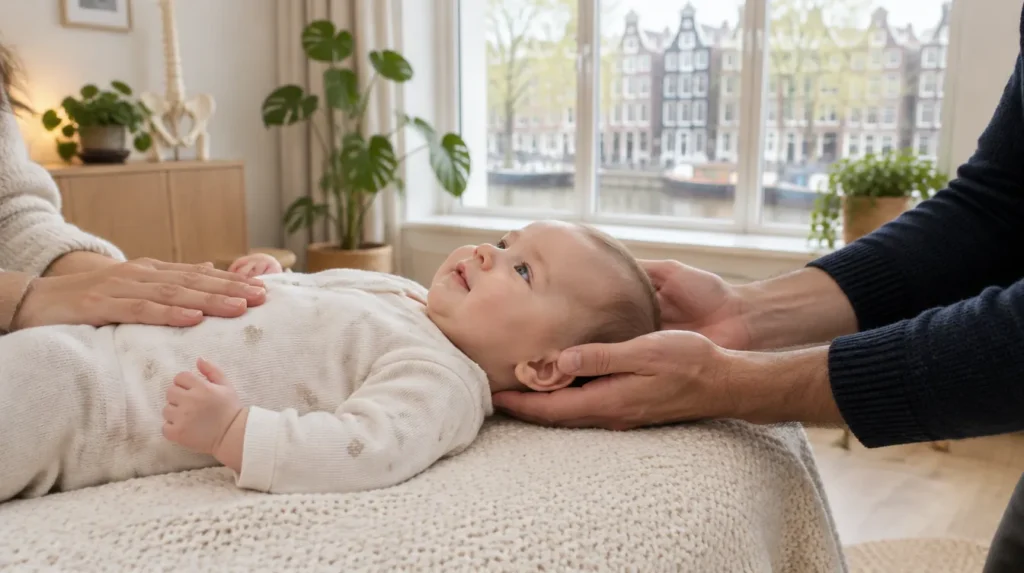
When I treat, I only use light techniques: gently follow and support with my hands, without squatting and without fast or powerful movements. You are always there and your baby can drink or sit on your lap. After two to three treatments we evaluate together. If nothing has changed, we will stop. In a baby with these signals, I see osteopathy as a supplement to the child health clinic, the GP and the pediatric physiotherapist, not as a replacement. When a visit makes sense, read up When do you take your baby to the osteopath?
Sources
- Happle C et al., Klinische Pädiatrie, 2009: no evidence for KISS as a clinical picture
- Folkehelseinstituttet (Norway), 2009: diagnosis and treatment of babies with suspected KISS
- Brand PL, Engelbert RH, Helders PJ, Offringa M, Dutch Journal of Medicine, 2005: systematic review of the treatment of KISS
- Driehuis F et al., 2021: reliability of neck tests in infants
- Sacher et al., 2022: randomized study of manual treatment at KISS
- Genelot et al., 2025: osteopathy to prevent skull flattening
- Koch, Biedermann and Saternus, 1998: Infant responses to an impulse in the upper neck
- Driehuis F et al., 2019: side effects of manual therapy in children
- NCJ, JGZ guideline Preferred posture and skull deformity, 2012
- NCJ, leaflet for parents about preferred position
- NCJ, JGZ guideline Excessive crying, revised 2025
- KNGF and NVMT, manual therapy file for children and infants
- Home doctor, My baby spits up a lot (reflux)
Written by Niels Tuijl, osteopath D.O.-MRO and physiotherapist, with more than ten years of practical experience. Registered in the Dutch Register for Osteopathy (NRO). Practice in Amsterdam Center (Herengracht) and Amsterdam North (Bercylaan). Last updated: October 26, 2026.