Written by: Niels Tuijl, osteopath D.O.-MRO in Amsterdam.
With a well-trained osteopath who works with light techniques, the chance of serious damage to your baby is very small. The serious complications described in the medical literature in infants almost all followed forceful or forced actions on the spine. These do not belong on a baby. What often happens is a baby who is a little more restless or sleepier for a day after treatment.
Yet “safe” is not the whole answer. Safe is different from effective, and the greatest risk is often not in the treatment itself, but in what can be missed. Below you can read what the research says, where the risk lies, which reactions are normal after treatment and how you can recognize a careful osteopath.
What the research says about safety
There is no major research that calculates exactly how often something goes wrong with osteopathy for babies. Various research groups have compared all available studies and reports. Together they provide a fairly consistent picture.
- Mild reactions occur, serious ones are rare. A 2018 review of nineteen studies of manual therapy in babies who cry a lot counted nine mild side effects in 1,308 babies treated. That's about 7 in 1,000.
- The difference is in the technology. In 2019, researchers from Radboud university medical center listed all studies into manual therapy in children. After gentle mobilization they found only mild reactions that resolved quickly. The five cases of severe damage described all followed rapid, forceful spinal manipulations.
- Often there was something else going on. In the severe cases, the child often had an underlying condition that had not been recognized. This was also reflected in an international literature review from 2015, which collected fifteen serious incidents in babies and children, spread across various professional groups.
There is an honest caveat to this. Many studies of manual therapy in infants did not systematically track side effects. A 2012 Cochrane review found that only one of six studies did so. Few notifications does not automatically mean that nothing ever happens. That is why it is wise to know where the risk lies.
Where does the risk lie?
Force on the neck and back
The severe cases in the literature have one thing in common: force was applied to a baby's spine. This usually involved quick, twisting or stretching manipulations, the kind of action where you hear a “crack”. But not only that. In 2009, Dutch doctors described the death of a healthy three-month-old baby after a craniosacral therapist forcefully held the neck and back in a deeply flexed position.
The lesson from this is clear: a baby does not require strength. No crunching, no fast movements and no positions in which your baby is held with force. If you see or feel that a practitioner is doing this, you can stop the treatment at any time.
Overlooking a medical cause
In practice, this is the more realistic risk. Dutch pediatricians kept track of the damage they saw after alternative and complementary treatments in children for three years. In 22 of the 32 cases, this involved indirect damage: a child who received the correct medical care too late.
A baby who cries a lot, drinks poorly or constantly overstretches may have a medical reason for this. According to Thuisarts, about 5 in 100 babies who cry a lot have a physical cause. You don't want to miss that, and an osteopath is not a doctor. A careful osteopath recognizes the alarm signals and then directs you instead of treating you. What signals these are can be found in my article when you take your baby to the osteopath.
Continued treatment without results
A treatment that changes nothing costs money and time. It may also mean that you only find out later about the help your baby needs. I therefore agree in advance that we will evaluate after two to three treatments. If nothing has changed, we will stop.
What the clinic guideline says
Consultation agencies work with the JGZ guideline on excessive crying, which was revised at the end of 2025. It states that the effect of osteopathy, chiropractic and manual therapy on excessive crying has not been proven, and that manual therapy can sometimes make a baby more restless. If your clinic is cautious about osteopathy, that is understandable.
I therefore never see osteopathy for a baby as a replacement for the child health clinic or the GP. It is a supplement for parents who know that nothing medical has been found and who want to have it investigated whether there is a movement restriction in their baby's body. Most research has been done on excessive crying. A number of small studies show a decrease in crying time, but these studies are of low quality. For most other complaints in babies, there is too little good research to make firm statements.
Which reactions are normal after treatment
After treatment, a baby may be more restless, cry more the first evening or sleep longer than normal. This usually improves within a day, sometimes within two. Feeding, carrying and maintaining your normal rhythm is then enough.
Contact your doctor if your baby:
- gets a fever;
- clearly drinks worse;
- is drowsy or weak, or reacts less than you are used to;
- cries differently than normal, for example high and shrill;
- After two days you are still more restless than before the treatment.
In that case, please let me know as well. I want to know how your baby responds to treatment, even if it doesn't go well.
This is how you recognize a careful osteopath
Osteopathy is not a protected profession. It is not in the BIG register, and the title of osteopath is not legally protected. As a parent you must therefore decide for yourself who you end up with. Here's what you can pay attention to:
- Registration in the NRO. The Dutch Register for Osteopathy requires recognized training, basic knowledge of medicine, disciplinary law and 160 hours of further training every five years. The abbreviation D.O.-MRO shows that someone is registered there. You can check this yourself at osteopathie-nro.nl.
- An extensive intake. A careful osteopath asks about pregnancy, childbirth, drinking and growth, and wants to see the growth booklet from the clinic.
- Light techniques. No crunching, no fast movements and no forced postures.
- You're there. Your baby lies on the table or on your lap, feeding is allowed in between and you can always say that you want to stop.
- Referral is part of it. If there are alarm signals, the osteopath will send you to the GP or clinic and will not treat you.
- No promises. Anyone who promises that osteopathy will solve crying, reflux or colic is going further than the evidence allows. A careful osteopath will agree on an evaluation moment.
How I work with babies
I am an osteopath D.O.-MRO and also a physiotherapist, with more than ten years of experience. I mainly use that medical background at the beginning of an appointment. With a baby I always start by asking whether there is anything that a doctor should look at first. If I come across something that needs to be medically examined, I will refer it and not treat it.
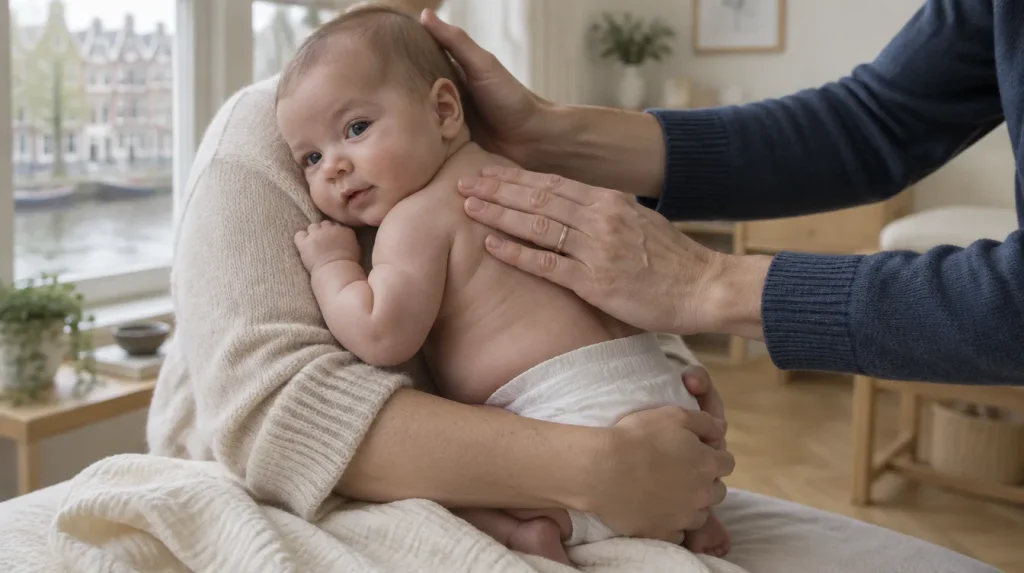
The treatment itself is feeling and following. I use light pressure to examine whether there are any movement restrictions, for example in the neck or around the pelvis, and whether these match what you see at home. Your baby lies on the treatment table or on your lap. Some babies sleep through it, others cry because they are on their back or are hungry. Crying during treatment does not mean it hurts.
Afterwards you will hear what I have found and whether I think I can help. If not, I'll say so. You can read more about the complaints parents present and how treatment works on the about page complaints in babies and children. My education and background stand out about me.
Sources
- Carnes D et al., BMJ Open, 2018: manual therapy for babies who cry a lot
- Driehuis F et al. (Radboud university medical center), PLoS One, 2019: side effects of manual therapy in children
- Todd AJ et al., Journal of Manipulative and Physiological Therapeutics, 2015: serious incidents after manual therapy in children
- Dobson D et al., Cochrane Database of Systematic Reviews, 2012: manipulative therapy for crying babies
- Holla M et al., Dutch Journal of Medicine, 2009: death of an infant after craniosacral therapy
- Rake JP, Vos BO, Vlieger AM, Dutch Journal of Medicine, 2021: damage from alternative treatments in children
- NCJ, JGZ guideline Excessive crying, revised 2025
- Home doctor, My baby is crying. What can I do?
Written by Niels Tuijl, osteopath D.O.-MRO and physiotherapist, with more than ten years of practical experience. Registered in the Dutch Register for Osteopathy (NRO). Practice in Amsterdam Center (Herengracht) and Amsterdam North (Bercylaan). Last updated: September 24, 2026.
Read more
- Treatment of complaints in babies and children
- When do you take your baby to the osteopath?
- Intestinal colic in your baby: causes and feeding tips
- Preferred position and a flattened head in your baby
- KISS syndrome in your baby: recognizing it and what you can do
- Rates and reimbursement via additional insurance
- Plan an intake immediately (book online)